Karl Marx Or D.L. Moody: Is Sin Or Oppression The Problem?
Ministries > Running To Win with Dr. Erwin W. Lutzer
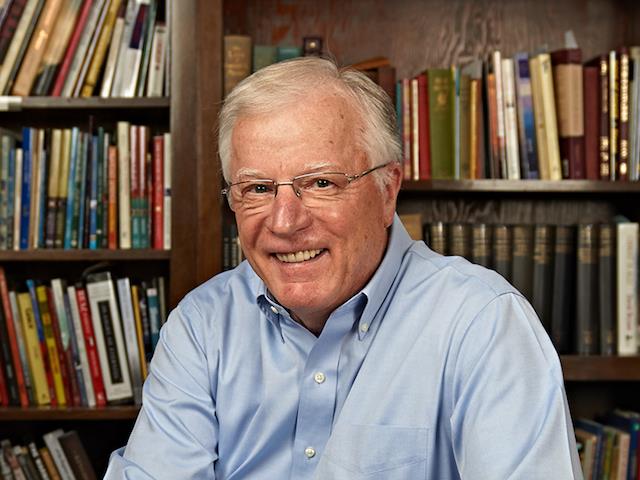
Poverty, injustice, evil: we all see them, but what is the root problem? As contemporaries in the 1800s, Karl Marx blamed oppression, but D.L. Moody said the problem was sin. In this interview, Pastor Lutzer and Dr. Gregg Quiggle weigh both diagnoses. Let’s discover how the crowning act of wickedness became the crowning act of grace.
Announcer: Let us run with endurance, the race that is set before us, looking to Jesus, the founder and perfecter of our faith. Two contemporaries, two gospels, two tombstones, one choice. Karl Marx and D.L. Moody. The contrast between these men could not be greater. The lessons they left behind are as divergent as night and day. Today, the first of two interviews about Marx and Moody, a book co-authored by Erwin Lutzer and Greg Quiggle. From the Moody Church in Chicago, this is Running to Win with Dr. Erwin Lutzer, whose clear teaching helps us make it across the finish line. Here now is Pastor Lutzer to set the stage for a hard-hitting look at Marx and Moody.
Dr. Erwin W. Lutzer: This is Pastor Lutzer. Welcome to a very special edition of Running to Win. Today I have with me in the studio an author, I'll introduce him to you in just a moment. We have written a book together and I want to explain how this book came about because you might be surprised at the title. About a year ago, I was in London co-leading a tour to the sites of the Protestant Reformation, when some of us went there early because we wanted to go to the tomb of Karl Marx. I wanted to do that, I wanted to give a lecture there so that people would understand what he taught and his continuing influence. We've heard a lot about him, but oftentimes we forget his tremendous impact throughout the world—a negative impact, I might say. But as I was preparing the lecture, I realized that he was a contemporary of none other than D.L. Moody, who of course founded the Moody Church and the Moody Bible Institute. So my lecture turned out to be Marx and Moody. So I want to introduce a book to you that is entitled Marx and Moody: Two Contemporaries, Two Gospels, Two Tombstones, and One Choice. Well, with me today is Dr. Greg Quiggle. Now Greg, you have been a professor at the Moody Bible Institute in the past. Tell us, what did you teach?
Dr. Greg Quiggle: Primarily in the field of church history. I taught church history, historical theology, occasionally I taught philosophy and apologetics, but primarily church history and historical theology.
Dr. Erwin W. Lutzer: I have to ask you right at the beginning here, what gave you so much interest in D.L. Moody?
Dr. Greg Quiggle: Interestingly, I was taking a doctoral seminar in a course called "The Social Gospel." And so I asked if I could do my paper on Dwight Moody. And the professor said okay, and I did it, and I was somewhat critical about Mr. Moody because the secondary literature said, well, Mr. Moody was the guy who turned evangelicals away from social action. So I read that and I went to the professor, who by the way was a Roman Catholic, and he said, "Well, that's interesting. What's the name of the school you work at, and who's been running all these rescue missions and doing all this work? You better go back and read again." So I did, and I completely missed who Mr. Moody was and what he was doing.
Dr. Erwin W. Lutzer: Well, we're going to get into that in just a moment, but I want to emphasize that I wrote the first section of the book on Karl Marx, and you wrote the section on Moody. And we're going to be explaining to people why Moody is still very relevant, especially to young people. But also we want to help them to understand the teaching of Karl Marx, how we are affected by it, and how to respond to it in a world that I think oftentimes has lost its way. Now, after I gave that lecture, I discovered something. When Moody was having his great crusades in London at the end of the 1800s, Moody was there during the time that Marx was there because Marx spent the last years of his life in London, as did Engels, who helped write the Communist Manifesto. Now we have no evidence that Marx attended one of Moody's meetings, but Engels did. And he wrote about it and he argued that this was the way in which religion is being used to keep the workers, the poor people, in check. Fascinating comment. And then before he died, Engels said these words, as he was reminiscing: Why didn't England join the revolution and become communist? After all, the Communist Manifesto was published in England for the first time in 1848. And he concluded it was because of Moody and Sankey and the Salvation Army. So if there are members of the Salvation Army who are listening to us today, your organization can take part of the credit because what happened was there were not enough revolutionaries who were willing to kill and who were willing to maim people, people who would be thrown into jail if they owned anything. There weren't enough revolutionaries who were willing to do that. And so that is a very interesting part of history. But I want to introduce people very quickly to Marx. Of course, this has to be very brief. He was born in 1818 in the Rhineland of Germany to Jewish parents. His father converted to Lutheranism, and he probably did it to escape persecution. But I want to read a letter that his father, Friedrich, wrote to Karl when Karl was 18 years old. And I can read only a couple of lines for lack of time. "There are times I cannot rid myself of ideas which arouse in me sad foreboding and fear, when I am struck as if by lightning by the thought: Is your heart in accord with your head and your talents? Has it room for gentler sentiments?" And now notice this line: "And since that heart is obviously animated and governed by a demon not granted to all men, is that demon heavenly or is it Faustian?" Now to all who are listening, if I mention the name Faust, what comes to mind? Many of you would say, "Well, he's a man who in the Middle Ages, it is said, he sold his soul to the devil and went to hell." Yes, but that's not the Faust that this letter refers to. That is a Faust that was written by Johann Wolfgang Goethe. And if you're not German, it's very difficult to pronounce that last name. But here's the point. That Faust makes a pact with the devil and still outwits the devil and gets to heaven. And you know, when you look at the poetry of Karl Marx, in the book I quote about five poems, I want to just give people a very quick vision. "Heaven have I forfeited, I know full well. My soul, once true to God, is chosen for hell." Wow. I think, for example, of the words of Richard Wurmbrand, who spoke at Moody Church during the 1980s. He was persecuted because of his Christian faith in Romania. And he said that communism was actually collective demon possession because the people who did the persecution took so much delight in persecuting people, in harming them in ways that are just unmentionable. So I think we have an answer to Karl Marx's father's question: Was his demon heavenly or was it Faustian? But enough about Marx. Let's talk about Moody. Okay, when was he born?
Dr. Greg Quiggle: 1837. He's born in rural Massachusetts, what they refer to as Western Mass, in the town of Northfield, right by the Vermont-New Hampshire border, right on the Connecticut River. He is born on his mother's birthday, and the family is actually quite poor. Most people think his father was an alcoholic; that's probably the case. They were deeply in debt. His father comes home one day, Dwight is about four years old, his mother is pregnant with twins. He's complaining that his father is complaining of a pain in his side. He dies that day. They are so far in debt that by that evening, the debt collectors have come and stripped many of the things from the house, including the kindling wood. His dad was a bricklayer; the family hid his tools in the attic to keep the debt collectors from taking them. So Dwight grew up as a child of poverty, a single-parent home, mother raised him alone.
Dr. Erwin W. Lutzer: Now, as we hurry through his life, obviously he comes to know Christ as Savior in Boston.
Dr. Greg Quiggle: Yes, he eventually goes to Boston. He is a driven young man looking to make what was the equivalent of a million dollars, a hundred thousand dollars. He ends up in Boston, he ends up selling shoes, and the condition of his job, his uncle gives him a job and the condition is he has to attend Sunday school. And there his Sunday school teacher, a man named Mr. Kimball, is concerned about Moody. He actually visits Moody in the store and shares the gospel with him, and Moody accepts Christ.
Dr. Erwin W. Lutzer: And what a remarkable story. And then of course he comes to Chicago, and that impacts all of us. By the way, if you've just tuned in, I want you to know that this is a very special edition of Running to Win. We're speaking about a brand new book entitled Marx and Moody: Two Contemporaries, Two Gospels, Two Tombstones. You say, "Well, why do you add tombstones?" Well, at the end of the book, we actually go to the graves and discuss what is there on their tombstones to talk about their various legacies. For a gift of any amount, we're making this book available for you. I'll be giving you some contact info in just a moment. But I want to explain: Why is it that we wrote this book? It's because we want to showcase two different worldviews. You know, when you look at the world today, you can see the evil around us, you can see human need, you can see people wallowing in their guilt, wondering where to turn. And what we see in Marx and Moody is a contrast between a humanistic view of the world and also, of course, in Moody, a divine, eternal perspective because of the gospel of Jesus Christ. Now, this is what I'm going to do. I'm going to give you very quickly what Marx wrote in the Communist Manifesto, just two of the most important points. Actually, in the book there are six points; I have time only for one or two, and then we're going to turn it back to Moody. Because as we think about Moody, I want people to grasp this: He is a showcase as to what God can do through anyone who's totally yielded to him. As a matter of fact, Greg, who actually told him that?
Dr. Greg Quiggle: Henry Varley in 1873.
Dr. Erwin W. Lutzer: And you know, I read somewhere that Moody, he of course was so impacted by that statement, but Varley couldn't remember he mentioned it to him. Yes, it's amazing. So God can do anything. In fact, we should not limit as to what God can do through anyone who's totally devoted to him. And if you want to know more about Moody, this of course is a book that really you should read and read carefully. Very quickly, Marx looked at the world and Moody looked at the world, and they saw a lot of injustice, didn't they?
Dr. Greg Quiggle: Yes, they did. The world that they lived in was incredibly poverty-stricken, massive injustice. So, for example, working-class people worked 12 to 16 hours a day, six days a week. They lived in incredibly difficult situations, paid poor wages. Housing was incredibly unsafe, sanitation was unheard of. It was just a terrible, especially in the cities, a terrible living situation.
Dr. Erwin W. Lutzer: And what I want to do is to outline very briefly the first two points of the Communist Manifesto, which addresses that. And then I'm going to turn to you and we're going to talk about Moody and what he had to say about it, and also to help people to understand what the real message is that we need to get to people. Obviously, their physical needs are very important, but they are not all-important. All right, the Manifesto. What Karl Marx begins by saying is this, and I'm doing it from memory. He says it is important, number one, that all things are to be owned by the state. As a matter of fact, to put it more clearly, the abolition of private property, that's number one. You see, what Marx decided was this: People argue over money. They go to war over money. You have, of course, the people who had factories; they took advantage of people for money. What if nobody owned anything? What if the state owned everything, and then the state could divvy it out in accordance with equity and everybody would be very, very happy, and everybody would wake up in the morning excited to work for the state? And people don't understand that in socialism. And by the way, at the end of the book, I also talk about how Karl Marx viewed the difference between socialism and communism. But be that as it may, at the end of the day, people would say to themselves, "Why, this is a form of paradise." Well, it didn't turn out that way. And then number two, very quickly, is all faith in God has to be transferred to faith in the state. I want to say this quickly and then we're going to be getting back to Moody in just a moment. Marx viewed human beings as people who were controlled by oppression. Take away the oppression, and evil, crime will basically disappear. Why is it that people, they steal and kill? It's because of oppression. Take away the oppression. Destroy the family—that's actually the next point—because you see, men oppress their wives, parents oppress their children, they take them to church and God is the ultimate oppressor. So get rid of God and you'll no longer have oppression. It didn't turn out that way, did it? Now, Moody looked at the same situation and what was his message?
Dr. Greg Quiggle: His message was the problem is sin. In fact, he called it "ruined by sin." He said all human beings are ruined by sin. The problem is not oppression. The problem is there was something deeply, fundamentally wrong with us that the Bible calls sin. And Moody said unless you deal with this core issue, really all you're doing is moving the deck chairs around on the Titanic because you're only dealing with the symptom and not the fundamental problem. And so he said you have to address this problem of human sin in order to really get at the problems that both he and Marx saw happening in the urban centers in the Western world.
Dr. Erwin W. Lutzer: And first of all, and I love the three R's, right? Ruined by sin. What's the second one?
Dr. Greg Quiggle: Redeemed by Christ. And the third one is regenerated by the Holy Spirit.
Dr. Erwin W. Lutzer: And that of course is transforming. People have to understand this. Marx and Moody fundamentally saw humanity very differently. Marx believed everybody is good. Take away the oppression and suddenly you will find all of this flourishing of human nature. Moody understood we are fatally flawed. You know, when it comes to Moody, people have to understand—and I sure don't have time to do it here—but people need to understand that Moody also spoke very much to the social conditions. And that's the thing, of course, that you discovered in your studies of Moody. And by the way, your part of the book highlights that very, very clearly. And what we need to do is to be able to understand the fundamental issues but then, of course, speak to all the other issues. Greg, I hope that when we return in our next time together, that you have time to tell us about Moody. I know that he was having a haircut with a President of the United States and how that went, and also his large crusades in London. What a remarkable story. And by the way, in the first chapter of your book, I love the way in which you outlined all of the headlines in the Western world regarding Moody's fame. Just imagine preaching to 20,000 people a night without a microphone back in the 1800s. Remarkable. I want to say a word to all those of you who are listening. From my heart to yours, I want to thank you so much for your prayers. Thank you for the opportunity that we have to share the good news of the gospel of Jesus Christ. And as I already mentioned, it is because of your prayers and because of your gifts that Running to Win can continue and even can expand to other countries. What we want to do here is to help people to be able to realistically evaluate our situation in life, to see our sin, but also to see the wonders of God's grace. Greg, I think we have time for a line or two, if you have it there, of one of Moody's sermons. Share with us how he, with such a sense of immediacy, shared the gospel with people.
Dr. Greg Quiggle: Yes, if I can read briefly. Once Moody was preaching on the power of Christ's blood to forgive sins, and he says: "Look at that Roman soldier as he pushed his spear into the very heart of the God-man. What a hellish deed. But what was the next thing that took place? Blood covered the spear. Oh, thank God, blood covers sin. There was the blood covering the spear, the very point of it. The very crowning act of sin brought out the very crowning act of love. The crown act of wickedness was the crowning act of grace." Moody believed, and we believe, that it does not matter what you have done. Nothing is beyond the capacity of the blood of Jesus Christ to forgive. God's grace extends to all sin, regardless of who you are. God offers forgiveness in and through his Son Jesus and his shed blood on the cross for you.
Dr. Erwin W. Lutzer: My friend today, isn't that good news in a world that has lost its way, a world that is obsessed with its guilt, not knowing where to turn? That's the news that you and I need to hear. And I can't help but think that there are many people listening to Running to Win today and you specifically needed that message. Yes, even the person, even the soldier that pierced the side of Christ is one who can be redeemed by that blood. For a gift of any amount, we're making this book available for you. It's entitled Marx and Moody: Two Contemporaries, Two Gospels, Two Tombstones, and One Choice. Here's the information that you need. I sure hope that you have a pen or pencil handy. You can go to rtwoffer.com. That's rtwoffer.com, of course, rtwoffer is all one word. Or if you prefer, you can pick up the phone and call us at 1-888-218-9337. Ask for the book entitled Marx and Moody. It will motivate you to godliness, it will help you to understand our culture, but thankfully also it will point to hope. Young people need to read this book, as all of us do, so that we might be able to interact with this world and at the same time highlight the grace of the Lord Jesus Christ. We here at Running to Win, and you've heard me say this many times before, are deeply appreciative because of people just like you. Running to Win is now in 50 different countries in seven different languages. So from my heart to yours today, I want to thank you so much. Many of you pray for us, what an encouragement that is. Many of you support this ministry, and as I frequently have mentioned, it's because of people just like you that Running to Win can go around the world sharing the good news of the gospel of Jesus Christ. Even as D.L. Moody preached: The blood of Jesus Christ, God's Son, cleanses us from all sin. Thank you so much for joining in with us as we join hands together running toward the finish line. And I'm so glad that you have joined us in this journey. God's best to you.
Announcer: Running to Win comes to you from the Moody Church in Chicago to help you understand God's roadmap for your race of life. Tomorrow will be the last day you can ask for a copy of Marx and Moody as our gift to you when you give a gift of any amount to support Running to Win. This book clarifies the contrast between darkness and light, and it will be sent at your request. For full information, call us toll-free at 1-888-218-9337. That's 1-888-218-9337. Online, go to rtwoffer.com. That's rtwoffer.com. Or write to us at Running to Win, Moody Church, 1635 North LaSalle Boulevard, Chicago, Illinois, 60614. Thanks for listening. For Pastor Erwin Lutzer, this is Dave McAllister. Running to Win is sponsored by the Moody Church.
Related Episodes
Karl Marx Or D.L. Moody: Whose Legacy Will Last?
Friday, September 25
An Extraordinary Return – Part 2 of 2
Wednesday, September 23
An Extraordinary Return – Part 1 of 2
Tuesday, September 22
Related Videos

About Running To Win
Running the race of life is hard. But with the Bible front and center and a heart to encourage, Pastor Erwin Lutzer presents clear Bible teaching, helping you make it across the finish line. Since 2011, this 25-minute program has provided a Godward focus and features listeners’ questions.
About Dr. Erwin W. Lutzer
Dr. Erwin W. Lutzer is Pastor Emeritus of The Moody Church where he served as the Senior Pastor for 36 years (1980-2016). He earned a B.Th. from Winnipeg Bible College, a Th.M. from Dallas Theological Seminary, a M.A. in Philosophy from Loyola University, and an honorary LL.D. from the Simon Greenleaf School of Law (Now Trinity Law School).
A clear expositor of the Bible, he is the featured speaker on two radio programs: Running to Win—a daily Bible-teaching broadcast and Songs in the Night—an evening program that’s been airing since 1943. Running To Win broadcasts on a thousand outlets in the U.S. and across more than fifty countries in seven languages. His speaking engagements include Bible conferences and seminars, both domestically and internationally, including Russia, the Republic of Belarus, Germany, Scotland, Guatemala, and Japan. He has led tours to Israel and to the cities of the Protestant Reformation in Europe.
Pastor Lutzer is also a prolific author of over seventy books, including the bestselling We Will Not Be Silenced, One Minute After You Die, and the Gold Medallion Award winner, Hitler’s Cross. Pastor Lutzer and Rebecca live in the Chicago area and have three grown children and eight grandchildren. Connect with Pastor Lutzer on X (@ErwinLutzer) or moodymedia.org.
Contact Running To Win with Dr. Erwin W. Lutzer
Mailing Address
Moody Church Media
1635 North LaSalle
Chicago, IL 60614
Toll-free Phone Number
1.800.215.5001
Monday – Friday
8:00am – 5:00pm CST
Fax Number
1.312.642.4904


