Exodus 20:18—21:36
Ministries > Thru the Bible with Dr. J. Vernon McGee
https://www.oneplace.com/ministries/thru-the-bible-with-j-vernon-mcgee/
Facebook Twitter Instagram YouTubeImagine the worst thunderstorm you’ve ever experienced. Multiply that times a thousand, and you’ll get an idea of what it was like for the children of Israel to be in God’s presence. They were terrified, ashamed, and entirely imperfect. Follow along as Dr. McGee teaches us how the Creator of the Law is the same One who saves us from our inevitable inability to keep it.
References
Steve Schwetz: It's a great day to study God's word. Welcome to Thru the Bible. I'm Steve Schwetz, inviting you to hop aboard the Bible Bus as we continue our journey through God's entire word. In this study, Dr. J. Vernon McGee reminds us that the Ten Commandments were only one part of the law given to the Israelites. God also gave them social laws and detailed instructions for building the tabernacle. Dr. McGee brings it all close to home as he explains how the instructions for building an altar relate to believers as well. So grab your Bible, and while you find your place in Exodus, here's the conclusion of Dr. McGee's thoughts on memories that we started last time.
Dr. J. Vernon McGee: May I say that memory can be a very sweet thing? It can be a very wonderful thing. Many of you listening today have a memory that is very sweet, is it not? Most of us here in California, we came from back east, did we not? Can you remember when you were a young person and lived somewhere in the Midwest? Probably you lived up in, well, Ohio. Maybe you lived down in Kentucky, or maybe you lived in New England, or maybe you lived down in Georgia, or maybe, as I did, in Oklahoma and Texas and Tennessee as a boy. Do you go back to a time in memory of your days at school? Do you remember the first sweet art that you had? Do you remember your mother? Do you remember your father? Do you remember those exciting times in the past? Do you remember when you met your wife or you met your husband? Do you remember when you proposed? Do you remember the wedding? Do you remember the birth of the first child? Do you remember when sadness came in—the word of death? My, memory is a wonderful thing, isn't it? And as I've been speaking, many of you have gone back in your mind's eye, back over the past to very pleasant days. And yet, some of us have some very horrible things in there also. Now, the child of God ought to also remember. Do you remember before you were saved? How many of you can remember before you were saved? And if you ever get a little discouraged as a Christian, you ought to go back to those days.
Steve Schwetz: Yes, remembering how God has worked in our lives is a great way to remind us of why we can trust him with the future. I can think of several great examples in my own life, can't you? Now, let's pray and praise him as we open his word together. Heavenly Father, thank you for the work that you've done in the past, the work that you're doing now, and the work that you will do in the future. Help us to trust you in every circumstance. We pray that your word reaches far and wide. In Jesus' name, amen.
Dr. J. Vernon McGee: Now today, friends, we find that we've come to this 20th chapter, verse 18. Last time we saw the giving of the law—that is, the part of the law that we call the moral law, the Ten Commandments. Now, he's not through by any means, because in the next few chapters—in fact, through chapter 24—we have social legislation. And then we have the instructions for building a tabernacle, and Leviticus, the service of it, and that's all part of the law. It all goes in one package, by the way. Now, I'm reading verse 18: "And all the people saw the thunderings, and the lightnings, and the noise of the trumpet, and the mountain smoking: and when the people saw it, they removed, and stood afar off. And they said unto Moses, Speak thou with us, and we will hear: but let not God speak with us, lest we die." Last time, we called attention to the fact that the giving of the law is not a beautiful or a pretty thing. There are people that think that it is, and they are generally the folk that haven't read very much about it—that it was wonderful that God gave the law on Mount Sinai. Well, it's not presented to us that way here in the scripture. We saw before the thunderings and the lightnings and the danger that was, and now the people, very frankly, they backed off as far as they can get. And they tell Moses, "We are afraid, but we want you to speak to us, but not the Lord." "And they said unto Moses, Speak thou with us, and we will hear: but let not God speak with us, lest we die." Children of Israel didn't think it was pretty. And then verse 20: "And Moses said unto the people, Fear not: for God is come to prove you, and that his fear may be before your faces, that ye sin not." You see, the law presented a very high standard. The law of the Lord is perfect. Nothing wrong with the law, and it demands, therefore, perfection. And friends, if you're not prepared to give perfection, you better get on some other kind of standard or basis than saying you're saved by keeping the law, because if you're not perfect, you won't make it. The law is perfect. It demands that. And I thank God that under grace, he'll take a poor sinner like I am. Grace reveals something of the goodness and wonder of our God. Now, he continues on here, verse 21: "And the people stood afar off, and Moses drew near unto the thick darkness where God was. And the Lord said unto Moses, Thus thou shalt say unto the children of Israel, Ye have seen that I have talked with you from heaven. Ye shall not make with me gods of silver, neither shall ye make unto you gods of gold." Now, this is a very significant and important thing. Why did God appear in just this way unto the children of Israel? Well, the reason, I think, is quite evident, and it's simply because he wanted to impress upon them that he is the living God and that the idols around them—and they were idolaters, we'll find that out later—that down in the land of Egypt, all this business of worshipping the creature rather than the Creator. And he's now probably coming closer to these people than he'd ever come before. That's very important here to see. Now, we come to the mention of the altar here. God gives them the commandments, and along with the commandments, there's given an altar—altars for sacrifice. This is the same thing you have in your bathroom. You have a mirror, and underneath that mirror, you have a basin. The mirror reveals that you have a smudge spot on your face, and down beneath is a basin, and you wash your face with the basin. And so there is the mirror—the mirror's this law of God reveals his standard. But the law's perfect, man's not perfect, and it reveals that smudge spot. But thank God there's a basin down there, and that's the purpose of the altar. That altar speaks of the cross of Christ and the blood that he shed. Now, notice the instructions concerning this altar, because again, this is the altar they had to use before the tabernacle was made. And it was apparently an altar that everywhere they journeyed, they made one like this. They couldn't take this one with them. The one in the tabernacle was one that could be transported. Now, I'm reading verse 24: "An altar of earth thou shalt make unto me, and shalt sacrifice thereon thy burnt offerings, and thy peace offerings." Now, there's no sin offering here. Why? Well, we'll not get to that until Leviticus, because there could be no sin offering or trespass offering until the law was given. The peace offering reveals that man needs a sacrifice that reconciles him to God, and that Christ did make peace by the blood of his cross. And the burnt offering speaks of who he is, his worthiness, his ability to save. Now, this altar that's to be made of earth was the place they were to sacrifice burnt offerings, peace offerings, "thy sheep, and thine oxen: in all places where I record my name I will come unto thee, and I will bless thee." So obviously, they made an altar everywhere they went on the wilderness march until the instructions for the tabernacle were given. Now verse 25: "And if thou wilt make me an altar of stone, thou shalt not build it of hewn stone: for if thou lift up thy tool upon it, thou hast polluted it." Now, this seems strange to us today. In other words, there would be those that would say, "Well, let's make an altar of stone." And this man says, "I'm an engraver, and I think it'd be nice if we could have it attractive-looking and make it appeal and very beautiful-looking." Now, here is something that's a very delicate matter, but it's very important, and there's a great spiritual lesson that is here. God says that you make my altar, you make it of plain stone—no engraving. And the minute that a tool is put upon that, why, it's polluted, and I don't want anything that has to do with it at all. Now, we've gone way past this. And we've come to the place where today a great many people feel that there should be, in worship, things that are beautiful—that everything should be made as beautiful as possible, with music and soft lights, beautiful colors, and that the message should be given in very low tones and a very dignified manner and as flowery as it possibly can be. Well, we've come through that period and we've had that type of thing. It's quite interesting that that made no appeal to the unsaved world. Liberalism emptied our churches. Liberalism years ago couldn't have an evening service. Somebody said to me, "Why do you think that the liberals have got so involved today in all of this social setup?" Quite obviously, he wasn't doing anything for years, and he felt very much left out of it. A man said to me, "Well, why don't you start marching and protesting?" My friend, that's not my business. I have too much to do. I keep busy without marching or protesting. Mine's not a protest. Mine is a positive message, and I'm not protesting anything. I'm just giving out the word of God, and it steps on a lot of toes, I can tell you that. But it's the word that'll do it. We're to give it out as it is, and there should not be any attempt today to water down the message. Now, don't misunderstand me. As I say, this is a delicate subject. No one today has put more emphasis on having an attractive place of worship. I've had the privilege of remodeling the interior of the Church of the Open Door in my ministry. I had to go through a long period of just urging this upon the church before they were willing to do it. And it was at some expense. I'm for soft lights. I love beautiful music, and I love flowery speaking. But my friend, when any of these things obscure the message of the cross and take attention away from the person of the one who died on that cross, then that becomes the offense of the cross—a real offense. And that's the thing today that God does not want to have happen. And Paul, when he went to the city of Corinth, you will recall they were philosophical. There were quite a few of the priests there of the heathen religions trying to identify with all the sin of Corinth. And some of them did pretty well in identifying with it. They had many hippie types in the city of Corinth. But when Paul came there and saw the situation, saw that they were second-hand philosophers—they wanted to argue, they wanted to discuss, they wanted to appear intellectual, they wanted to appear to be hip, they wanted to belong to the "now" generation—my, how they were going in every direction. And Paul, who'd had a similar experience in Athens where they wanted to hear some new thing, Paul says, "I determined not to know anything among you, save Jesus Christ, and him crucified." And friends, if that's left out of the message, I don't care how high the steeple is, I don't care how loud the church bell is, I don't care how beautiful the sanctuary is, I don't care how lovely and soft the music is, and I do not care how educated the preacher is that's in the pulpit—that is not a church. But may I say to you, that's anything but a church. That is polluted as far as God is concerned. The thing that is important is the message of the word of God. That's the thing that should go out today. There is an attempt to dress it up and to do something with it. This is very important to see here. This is instructions for the altar. We present just Jesus Christ and him crucified. That is our message that should be our message. Now, there's something else here, verse 26: "Neither shalt thou go up by steps unto mine altar, that thy nakedness be not discovered thereon." Now, there are a great many that would build some nice, lovely steps to go up to the altar. That would make it very convenient, you see. And when a man would step up—and they wore a type of a skirt in that day—why, the nakedness would be revealed. God says, "I don't want to see it." That which speaks of the flesh, God can't use. And let me make this very personal: anything that Vernon McGee does that's of the flesh, God hates it and God won't use it at all. God does not want a display of the flesh in anything that has to do with his work. We need to guard against that type of thing. And sometimes it disturbs me when people can only see the preacher and not see the one that he's trying to present. I personally don't like anyone to tell me it's a beautiful sermon. The last thing in the world I want to preach is a beautiful sermon. I want to preach a beautiful Savior, and I'd like for people to leave and say, "My, isn't Jesus wonderful?" Not that the preacher is—that doesn't make any difference about him. I've had very few real compliments since I've been a minister. But when I was a pastor as a student down in Georgia, on a little white and painted church on the side of a red clay hill, and one morning after the message, after everyone had left, a boy there—a country boy, and I mean country, friends; he wore high yellow shoes, button-up too, by the way. And he waited around as timid as he could be. He was really a country boy. After everybody left, why, he came up to me and tears were in his eyes. He took hold of my hand and he said, "My, I didn't know Jesus was so wonderful." And he wanted to say something else, but he wasn't able to say it. And he just turned and walked out of the church. And I watched him, because that church was in a cotton patch then. It's in the city there now, but that was a cotton patch in my day. And I saw him walk down across that cotton patch, and I watched him as he walked—that country boy. And he said he didn't know Jesus was so wonderful. And I said, "Oh God, let me so preach that people will think Jesus is so wonderful." That was a compliment. Haven't had many like that, by the way. And we don't need the display of the flesh in the ministry, in the pulpit, or in church work. Now, we come to chapter 21, and here we have this social legislation. It's quite interesting, some of the things that are dealt with here. And I'll begin reading at verse one, because this has to do with master and servant. And that was a pretty important issue in that day after all these people had been slaves in Egypt. "Now these are the judgments which thou shalt set before them. If thou buy an Hebrew servant, six years he shall serve: and in the seventh he shall go out free for nothing." In other words, they could never permanently make one of their brethren a slave. Now, verse three: "If he came in by himself, he shall go out by himself: if he were married, then his wife shall go out with him. If his master have given him a wife, and she have borne him sons or daughters; the wife and her children shall be her master's, and he shall go out by himself. And if the servant shall plainly say, I love my master, my wife, and my children; I will not go out free: Then his master shall bring him unto the judges; he shall also bring him to the door, or unto the doorpost; and his master shall bore his ear through with an awl; and he shall serve him for ever." Now, this is a remarkable thing that's put right here, and here's a picture of the Lord Jesus Christ, if there ever was one, and it's a beautiful one. The law is this: if a man is a slave and he can go out in seven years, and if he was married when he became a slave, he could take his wife out. But if while he's a slave that he gets a wife—and that means one that's a slave of his master—then he can go out but not his wife. She can't go out free. And so if he says though, "Well, I love my wife, and I love my master, I want to stay," and then he takes an awl and bores him through. Well, that's a picture of the Lord Jesus Christ. You say, "How in the world can that be a picture of him?" Well, I think a very wonderful picture of him. He came to this earth and he took upon himself our humanity, and we were all slaves of sin. He could have gone out free. He didn't have to die upon the cross. But he came down to this earth and he became a servant, obedient even unto death, and he died and went through the same gate we did in order that he might get a bride for himself. But he had to be crucified to do it. And the writer to the Psalms takes that picture and uses it over in Psalm 40, verse six: "Sacrifice and offering thou didst not desire; mine ears hast thou opened: burnt offering and sin offering hast thou not required. Then said I, Lo, I come: in the volume of the book it is written of me, I delight to do thy will, O my God: yea, thy law is within mine heart." And that refers to Christ. Somebody says, "How do you know it refers to Christ?" Well, if you would turn over to the 10th chapter of the Epistle to the Hebrews, why, we find there that it was fulfilled when our Lord came to this earth. Because in Hebrews 10:5, it says, "Wherefore when he cometh into the world"—now speaking of Christ—"he saith, Sacrifice and offering thou wouldest not, but a body hast thou prepared me." Now, it's not his ears he's digged, but he gave him a body. And Christ took upon himself a body, and he'll have that body throughout eternity. But he could have left this earth without dying, but he said, "I love the church. I love the sinner." And so he died and became obedient unto death, even the death of the cross. What a picture this is of Christ right here after giving the Ten Commandments. Now, we have here a series of laws that have to do with injuries to a person. I think it's well to note this, verse 12: "He that smiteth a man, so that he die, shall be surely put to death." Now, this is the basis for capital punishment. Now, a great many today, especially these young people, have been fed a bunch of malarkey today, a bunch of propaganda, and they are told that "thou shalt not kill" means you can't become a soldier. May I say that the Lord says that a government has a perfect right. "He that smiteth a man, so that he die, shall be surely put to death." The nation Israel could put to death any murderer. It's well to look at the total word of God, by the way. And then verse 13: "And if a man lie not in wait, but God deliver him into his hand; then I will appoint thee a place whither he shall flee." Now, we're going to come to that later—the cities of refuge. "But if a man come presumptuously upon his neighbor, to slay him with guile; thou shalt take him from mine altar, that he may die." In other words, if the murder's premeditated, the man is to be executed. Now, if he does not do it maliciously—and I think oftentimes in self-defense that a man without premeditation attempts to defend himself—I would say that that would not merit an execution at all. Now, will you notice how God protected the family? Verse 15: "He that smiteth his father, or his mother, shall be surely put to death." God certainly protected the home. "And he that stealeth a man, and selleth him, or if he be found in his hand, he shall surely be put to death." God did not approve slavery at all. It was the system in that day, and God always dealt with those things, but doesn't mean that he approves them—in fact, it's quite obvious he condemned it. "He that curseth his father, or his mother, shall surely be put to death. And if men strive together, and one smite another with a stone, or with his fist, and he die not, but keepeth his bed," why, then he's to reimburse him. You see, here's the basis of the laws of our land. Now, I'm not going to go down through all of these, but I would recommend that you read this because here is the basic of law and order in any nation. Must have something built on this, my friend, if they're to have a civilized nation. And it's in here, verse 24: "Eye for eye, tooth for tooth, hand for hand, foot for foot, burning for burning, wound for wound, stripe for stripe." In other words, friends, there is this law of reciprocity. This is a law that must be enforced if there is to be law and order and protection of human life and property. And thank God, though, that there is one who is prepared though to extend grace to us that we might be saved. So until next time, may God richly bless you, my beloved.
Steve Schwetz: As we break for the weekend, extend your time in God's word by joining me for one of Dr. McGee's never-before-aired Sunday sermons, "The Most Complicated Commandment". Listen on our app online at ttb.org or call 1-800-65-BIBLE if we can help you find a station that carries it. I'm Steve Schwetz, and I'll be here waiting for you to hop aboard the Bible Bus as it rolls along. We're grateful for the faithful and generous support of Thru the Bible's partners, whom God uses to take the whole word to the whole world.
Related Episodes
Exodus 20:1-17
Thursday, September 24
Exodus 19:4-25
Wednesday, September 23
Exodus 18:1—19:5
Tuesday, September 22
About Thru the Bible
Thru the Bible takes the listener through the entire Bible in just five years, threading back and forth between the Old and New Testaments. You can begin the study at any time. When we have concluded Revelation, we will start over again in Genesis, so if you are with us for five years you will not miss any part of the Bible.
Other Thru the Bible Programs:
Thru the Bible - Minute with McGee
Thru the Bible - Questions & Answers
Thru the Bible - Sunday Sermon
About Dr. J. Vernon McGee
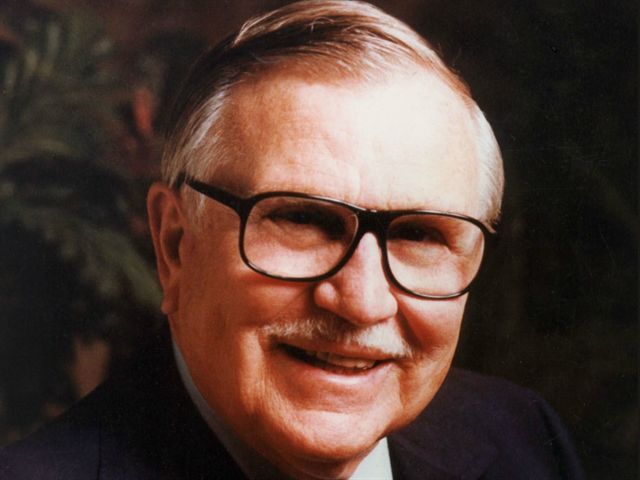
John Vernon McGeewas born in Hillsboro, Texas, in 1904. Dr. McGee remarked, "When I was born and the doctor gave me the customary whack, my mother said that I let out a yell that could be heard on all four borders of Texas!" His Creator well knew that he would need a powerful voice to deliver a powerful message.
After completing his education (including a Th.M. and Th.D. from Dallas Theological Seminary), he and his wife came west, settling in Pasadena, California. Dr. McGee's greatest pastorate was at the historic Church of the Open Door in downtown Los Angeles, where he served from 1949 to 1970.
He began teaching Thru the Bible in 1967. After retiring from the pastorate, he set up radio headquarters in Pasadena, and the radio ministry expanded rapidly. Listeners never seem to tire of Dr. J. Vernon McGee's unique brand of rubber-meets-the-road teaching, or his passion for teaching the whole Word of God.
On the morning of December 1, 1988, Dr. McGee fell asleep in his chair and quietly passed into the presence of his Savior.
Contact Thru the Bible with Dr. J. Vernon McGee
Mailing Address
Thru the Bible, Inc.
P.O. Box 7100
Pasadena, CA 91109
In Canada:
Box 25325,
London, Ontario
N6C 6B1
Phone Number
(626) 795-4145 or
(800) 65-BIBLE (24253)


