Leviticus 8:1-13
Ministries > Thru the Bible with Dr. J. Vernon McGee
https://www.oneplace.com/ministries/thru-the-bible-with-j-vernon-mcgee/
Facebook Twitter Instagram YouTubeToday’s stop on the Bible Bus covers the consecration of the priests. God used imperfect men to serve as a picture of Jesus’ role as living Prophet, Priest, and King. In Leviticus 8, discover how God takes the horizontal, earthly meanings of the Tabernacle and makes them vertical or heavenly.
References
Announcer: How firm a foundation, ye saints of the Lord, is laid for your faith in his excellent word.
Steve Schwetz: Welcome to Thru the Bible. I'm Steve Schwetz. When you hear the word consecration, what comes to mind? Maybe a special service, a prayer? Well, in Leviticus chapter 8, Dr. J. Vernon McGee turns that idea upside down. While we often think consecration is something we do for God, Scripture paints a very different picture. It begins with God and what he's done for us. Before we begin our study, let's listen to a couple of messages from our fellow passengers on the Bible bus. Here's Catherine.
Guest (Female): Hi, my name is Catherine. I live in Pineville, Louisiana. I'm 82 years old, and I'm on my, the beginning of my third journey of Thru the Bible. I love the Bible and God's Word, as it is the guide and instruction book for life. As I've gotten older and had more time to study, that's the focus that I find is you have to read God's word to know what God thinks and how he wants you to live. Thank you for Thru the Bible. Thank you for your faithfulness. I love you all, and I appreciate and support Thru the Bible. Thank you. I love you. Bye-bye.
Steve Schwetz: Well, thanks for your support, Catherine. It's a joy to have you traveling with us. Now here's a fun message from Tracy and Lori, who make the journey together.
Guest (Male): Hi, this is Tracy and Lori from Northern California, and we listen together to Thru the Bible Radio every evening. We are enjoying the book of Genesis. We finished with you guys last year through the book of Revelation. I think we've been listening to the Thru the Bible radio broadcast maybe, oh.
Guest (Female): A year, over a year.
Guest (Male): Yeah, about over a year, and we're very blessed. And here's Lori.
Guest (Female): Yes, I have to say that I didn't want to, listen to it every night. My goodness, it seems so daunting, but now that, I've been listening faithfully for this last year. It's been a blessing just to hear Dr. McGee's words of encouragement, of insight and everything. So thank you.
Guest (Male): Amen. Thank you very much, and keep the bus rolling. Bye-bye.
Steve Schwetz: I think a lot of people can relate to Lori. The thought of going through the entire Bible can seem daunting, but as Catherine reminded us, God's word is where we come to know his heart and then discover how he wants us to live. And that's what keeps us coming back. Let's pray. Father, thank you that through your word we can know you more deeply. Help us to see you more clearly as we study together. In the name of Jesus, amen. We're off to Leviticus 8 on Thru the Bible with Dr. J. Vernon McGee. Now, friends, we come today to this 8th chapter of Leviticus, and this is an altogether new section we've come to. Here we have the consecration of the priests, and this is a very important section, and it'll throw a great deal of light on what is called consecration today in our churches. And I tell you, what we do today is a pretty sorry substitute for the real article, by the way. Now we have our attention directed to the priests and not the sacrifices. We've been talking about the sacrifices, but now it's the priests.
Dr. J. Vernon McGee: And we are going to leave the brazen altar where the sacrifices were made, and we'll now turn to the brazen laver. You see, at the brazen altar, God dealt with the sin question for the sinner once and for all. But that doesn't mean that the saved sinner is perfect. He sins, unfortunately. But God has a brazen laver where he washes them, keeps them clean. And he's girded with that towel of service, and he washes us in the brazen laver today of the blood of Christ, God's Son, that just keeps on cleansing us from all sin. Now we see another similarity here, that Israel had a priesthood, and this is for them. In fact, the book of Leviticus is really for the Levites, and the church today is a priesthood. You see, it was God's original intention to make the entire nation of Israel a kingdom of priests in Exodus 19:6. I called attention to that when we were in Exodus. Ye shall be unto me a kingdom of priests, a holy nation. These are the words which thou shalt speak unto the children of Israel. Now, their sin in the matter of the golden calf prevented Israel from becoming a nation of priests. So God chose one tribe, and at first Aaron was the high priest. Now today the church is a priesthood with Christ as the great high priest. And by the way, in the future on the earth, I believe that in the millennium that the nation Israel will be the priests on the earth in that day. Now, we find today that the church is a priesthood with Christ as the great high priest. Listen to the writer to the Hebrews, for that actually is what Hebrews is all about. In 8:1, I read, now of the things which ye have spoken, this is the sum. We have such a high priest who is set on the right hand of the throne of the majesty in the heavens. And again, Peter writing says in 1 Peter 2:9, but ye are a chosen generation, a royal priesthood, a holy nation, a peculiar people, that ye should show forth the praises of him who hath called you out of darkness into his marvelous light. And then in Revelation 5:10, I read, and has made us unto our God a kingdom of priests, and we shall reign on the earth. And then in Hebrews 13:10, we have an altar whereof they have no right to eat, which serve the tabernacle. Now that altar today is in heaven. It's a throne of grace, we're told. And in Revelation 1:6, and hath made us a kingdom of priests unto God and his Father, to him be glory and dominion forever and ever. Amen. Now, what is a priest? Well, we are given the definition of a priest in Hebrews 5:1. For every high priest taken from among men is ordained for men in things pertaining to God, that he may offer gifts and sacrifices for sin. Now you see, a priest is one who represents man before God, and he goes in to God on behalf of man. Priesthood in the scriptures bears no similarity to any order of priests in any religion of the present time. Altogether different. The priest represented man before God. Fact of the matter is that he's the opposite from a prophet. A prophet comes out from God to speak for God to man. A priest comes out from man to go to God to speak for man to God and to represent man. You see, the Lord Jesus is both prophet and priest. He came out from God and spoke for God to man. He reveals God to man. Now he goes from man back to God and is our great high priest. He represents us there. In fact, we're in him. And my friend, if you're not in him, you're not up there, because you and I could never get there on our own. By the way, at this particular juncture, a knowledge of the tabernacle is really essential to an understanding of Leviticus, and especially of the priesthood. And I would very much like to put in a commercial here and say that our book, The Tabernacle, God's Portrait of Christ, is still available. Now we have here a certain typology of the tabernacle and the priesthood that are so rich in meaning and detail that there is a danger of emphasizing, I think, one facet at the exclusion of another. And of course, we're limited by time, and we might give a wrong inference, and I don't want to do that. The ramifications at this point, may I say, are manifold. But I think truth should be held in a true perspective. And I think that we need to note that the outer court of the tabernacle represents the world down here where we are today. Here's where Christ bled and died. But that holy place is unseen, to which our great high priest has passed. Actually, what happened when the Lord Jesus died on the cross and went back to heaven, he took the tabernacle and the meaning of it, that actually it was horizontal with the earth. Now it's perpendicular. The altar was down here. He died on a cross down here, but he went back to the holy place up yonder. And we're told in Hebrews 4:14, seeing then that we have a great high priest that is passed into the heavens, Jesus the Son of God, let us hold fast our confession. And then in Hebrews 9:11, but Christ being come a high priest of good things to come by a greater and more perfect tabernacle not made with hands, that is to say, not of this building. And he's right now in the Holy of Holies. At this very moment, friend, that you're hearing this, he's up yonder. And if you're his, he's up there for you. Notice what the writer to the Hebrews says again in Hebrews 8, 1 and 2. Now of the things which we've spoken, this is the sum. We have such a high priest who sat on the right hand of the throne of the majesty in the heavens, a minister of the sanctuary and of the true tabernacle, which the Lord pitched and not man. Now he's up yonder for us today. I wish we could bring reality today into our faith. We go to a church and go through a little ritual. It's pretty milky, may I say. It's just sweetened water, saccharine sweetness. The realities of our faith are forgotten today. He's up yonder, friends, right now for you, and you can go to him. Oh, how wonderful. And we're told to come with boldness. Listen again, Hebrews 9, 23 and 24. It was therefore necessary that the patterns of things in the heaven should be purified with these, but the heavenly things themselves with better sacrifices than these. For Christ has not entered into the holy places made with hands, which are the figures of the true, but into heaven itself, now to appear in the presence of God for us. For whom? For us. He's up there for us. Oh, there is an availability today, an availability of God today, of Christ there for you and me. You're not alone down here. Therefore, this tabernacle is ended up. The Holy of Holies is up there. Now, 12 times in this chapter, we're coming to chapter 8, and all this is preliminary, you see, I'm giving, that the Lord commanded Moses. The final one, I think, is a clincher in the last verse. So Aaron and his sons did all things which the Lord commanded by the hand of Moses. This is what God commanded. Consecration today is not some little peewee service that is about as banal as anything can be, and just about as boring as anything can be. Burn a candle or throw a chip on the fire as if we're doing something. May I say that consecration is the way he says it's to be done. I think that when we have this here, that this is the answer to those who claim to believe in the inspiration of scriptures, but they accept the late dating of Leviticus as the invention of the priesthood. We got some folk that say they believe that. All right, God says here that they did this as God commanded by the hand of Moses. All right, what goes on here? If you say that you believe in the late dating of Leviticus and that you believe in the inspired word, then what are you believing? Inspired lies? Inspired falsehood? My friend, let's be consistent. If you believe in the late dating of Leviticus, you do not believe in the inerrancy of Scripture. You believe in something else. Now, we have here in chapter 8 something that's quite wonderful. We have the priests, and we have them now from chapters 8 through 10. And we have here the consecration of priests, the calling of the congregation to witness the ritual, the cleansing of Aaron and his sons, the clothing of the high priest, consecration of the high priest, clothing of the priests, cleansing of the priests, and Aaron by the blood of the offering. Now I'm going to begin reading in verse 1 through 3. And the Lord spake unto Moses, saying, Take Aaron and his sons with him, and the garments and the anointing oil, and a bullock for the sin offering, and two rams and a basket of unleavened bread, and gather thou all the congregation together unto the door of the tabernacle of the congregation. Now Moses is commanded here to bring Aaron and his sons with all the articles which are to be used in the consecration of the priests, and it sounds sort of like a grocery list, but it's very important what it speaks of. Then he's to gather the congregation together to witness the ritual of consecrating the priests. And this, I think, was a very impressive service. They will see that God takes feeble men and sets them aside for his service. And I feel like saying hallelujah at that basis because he'll do that for you and me today. Now, in Hebrews 7:28, I read, for the law maketh men high priests which have infirmity, but the word of the oath, which was since the law, maketh a son who's consecrated forevermore. Now, he's consecrated. I'm not really. We'll see what I mean by that. The marvelous thing is he takes men with infirmity. If he demanded perfection, I'd be left out. Thank God he takes them like that. Now, will you notice the articles that he uses? And Moses did as the Lord commanded him, and the assembly was gathered together unto the door of the tabernacle of the congregation. Now, Moses does what he's told to do, and the people likewise obey and come together for the service. Verse 5, and Moses said unto the congregation, this is the thing which the Lord commanded to be done. And friends, this is what God commanded. And now Moses gives a word of explanation. He's following the instructions of the Lord. Now you have the cleansing of Aaron and his sons. Verse 6, notice this. And Moses brought Aaron and his sons and washed them with water. He gave them a bath, if you please. Moses brings Aaron and his son, seed of the laver for washing. Now, this signifies that they're to be holy, pure, and clean if they're to serve the Lord. Now, they've already been to the altar for forgiveness, but they need cleansing. And that's the thing I insist on today, that a great many people say, well, I'm saved. You are? Hallelujah. And you think that justifies you to do any kind of service? And they say yes. And I say you're wrong. You have to be cleansed to be used. Listen to this. It's not by works of righteousness which we've done, but according to his mercy. He saved us by the washing of regeneration and renewing of the Holy Ghost. The Holy Spirit renews as we go along. We're told to draw near with a true heart and full assurance of faith, having our hearts sprinkled from an evil conscience and our bodies washed with pure water. What does that mean? That we've been to him for cleansing. And again, Paul in Ephesians 5:26 says, that he might sanctify and cleanse it with the washing of water by the word. You want a good bath? Let me suggest a good bar of soap, the Word of God. That'll clean you. That's what he says here. Listen to the Lord Jesus. John 13:10, Jesus saith unto him, He that wash needeth not save to wash his feet, but is cleansed every whit, and you're clean, but not all. And he's talking about Judas. And we are told if we confess our sins, he's faithful and just to forgive our sins and cleanse us from all unrighteousness. You want to be used of God, then go confess your sins, Christian. That's the first step. Somebody says, well, I don't like that. I'm not asking you that, whether you like it or not, God commanded it. You either do it his way or you don't do it. Because you see, he has his way of doing things. Now we have the clothing of the high priest, and this is a picture of our great high priest in all of his glorious graces and all of his beauty. Now notice, and he put upon him the coat and girded him with a girdle and clothed him with the robe and put the ephod upon him, and he girded him with the curious girdle to the ephod and bound it unto him therewith. Now there were eight articles worn by the high priest. Four were the same or similar to those worn by all the priests, but four were peculiar to him, and they were called garments for glory and for beauty, and that separated him from the other priests. Now, the four which were common to all the priests were these: the coat, the girdle, the turban, or the mitre, a bonnet, and the breeches. Now, these were all made of white linen, with the exception of the turban, and it had that blue on it. The white linen speaks of righteousness. Every believer is clothed in the righteousness of Christ, and to be thus clothed is essential for service, and also to be girded, it's necessary for active obedience. Now we have the coat and girdle mentioned in this verse. They were the basic garments which all the priests wore. Now we went over all of that back in Exodus, and I'm not going to repeat it today. And in verse 8, we're told he put the breastplate upon him. Also, he put the Urim and Thummim. Now, again, the breastplate is described back in Exodus 28, and if you want to review, you ought to go back and read that chapter. Now, the Urim and Thummim mean lights and perfections. They were placed in the breastplate, and I do not know exactly how they function. Some think that they had to do with the law, possibly the law written on stone. And in Psalm 19, there may be a reference to this. The law of the Lord is perfect. That's perfection, thumin. And the commandment of the Lord is pure, enlightening the eyes. That's light, urim. I think that there is that spiritual application, and I think that these two had something to do with determining the will of God. And we need the word of God, and we need the leading of God to determine the will of God in our lives today. We need the Urim and Thummim, whatever that meant, I'm not quite clear. Now, verse 9, he put the mitre upon his head, also upon the mitre, even upon his forehead did he put the golden plate, the holy crown, as the Lord commanded Moses. Now this was put upon him, and it was holiness unto the Lord. These garments distinguish the high priest from the other priests, and we need to recognize you and I can come as lost sinners to Christ, and we can come today as soil saints, but my brother, you and I have to know he's holy, and he'll not tolerate sin in our lives. If we're going to come and accept him as Savior, we turn from sin to him. If we are to serve him today, we have to deal with sin in our lives. Now, will you notice as I move on down, we have the consecration of the high priest in verses 10 and 12. And Moses took the anointing oil and anointed the tabernacle and all that was there and sanctified it. It had been sprinkled with blood before, now it's anointed with the oil. This means that they were redeemed and cleansed articles, redeemed the blood, the oil, the Holy Spirit cleansed, and the Holy Spirit's represented by the oil, and he's free to move and work in the worship and service of the tabernacle, you see. And we're told today that we are to worship God in spirit and in truth. Now he sprinkled on the altar, we're told here, verse 11, seven times anointed the altar, all his vessels, both the laver and the foot of it. Now this act of sprinkling the oil speaks of sanctification. All was now ready for use, each article of furniture set apart for the service of God. Notice he poured of the anointing oil upon Aaron's head and anointed him to sanctify him. Now Aaron had the anointing oil poured on him, not sprinkled. It's like the precious ointment, we're told in Psalm 133:2, that ran down upon the beard, even Aaron's beard that went down to the skirts of his garment. My friends, he just covered with oil. He was a regular oil man. Now the Holy Spirit was poured upon Christ at his baptism, and he distinctly stated that the Spirit was given to him without measure. That was said in John 3:34. And it's noted that the oil was poured on Aaron before the priests had the blood applied to them. Our high priests needed no offering for sin, but we do. That had to come first. Now you have the clothing of the priests here, and Moses brought Aaron's son, put coats upon them. Now that means that they were doing it according to the commandment of God, and that they had to stand clothed in the righteousness of Christ. I'll have to leave off there today. We'll pick up next time at verse 14 and see the cleansing of the priests and Aaron by the blood of the offerings. This is important today for our consecration because this is a picture of what real consecration is. Until next time, may God richly bless you, my beloved.
Announcer: To reach us, drop a note in our app or visit TTB.org or email [email protected]. And if you loved hearing from Catherine, Tracy, and Lori, I know that others would love to hear from you too. So call and share your story, won't you? You can dial 1-800-65-Bible. It's super easy in the options. You're going to hear one for leaving your Bible bus story. That's what you want. From there, it's just as simple as listening to the prompt and then recording your voicemail, just talking to one person. That number again is 1-800-652-4253. I'm Steve Schwetz, and I'll meet you back here next time as the Bible bus rolls along. All to him I owe. Sin had left a crimson stain. He washed it white as snow.
Steve Schwetz: Thru the Bible exists to take God's whole word to the whole world, and we invite you to stand with us with your faithful prayer and financial support. Where will God's word go today?
Related Episodes
Leviticus 6, 7
Monday, November 23
Leviticus 5
Friday, November 20
Leviticus 4:13-35
Thursday, November 19
About Thru the Bible
Thru the Bible takes the listener through the entire Bible in just five years, threading back and forth between the Old and New Testaments. You can begin the study at any time. When we have concluded Revelation, we will start over again in Genesis, so if you are with us for five years you will not miss any part of the Bible.
Other Thru the Bible Programs:
Thru the Bible - Minute with McGee
Thru the Bible - Questions & Answers
Thru the Bible - Sunday Sermon
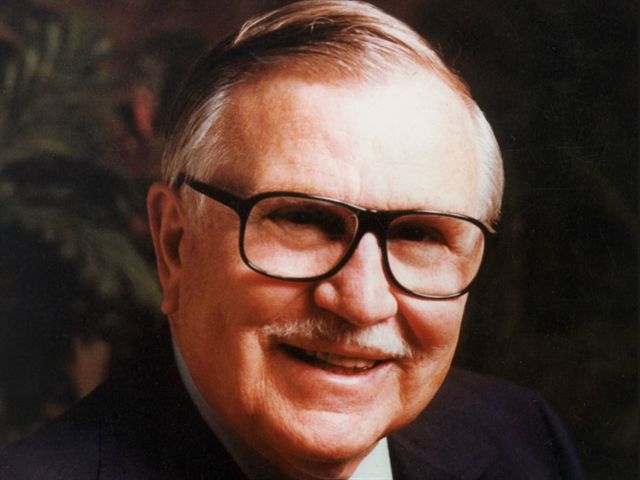
About Dr. J. Vernon McGee
John Vernon McGeewas born in Hillsboro, Texas, in 1904. Dr. McGee remarked, "When I was born and the doctor gave me the customary whack, my mother said that I let out a yell that could be heard on all four borders of Texas!" His Creator well knew that he would need a powerful voice to deliver a powerful message.
After completing his education (including a Th.M. and Th.D. from Dallas Theological Seminary), he and his wife came west, settling in Pasadena, California. Dr. McGee's greatest pastorate was at the historic Church of the Open Door in downtown Los Angeles, where he served from 1949 to 1970.
He began teaching Thru the Bible in 1967. After retiring from the pastorate, he set up radio headquarters in Pasadena, and the radio ministry expanded rapidly. Listeners never seem to tire of Dr. J. Vernon McGee's unique brand of rubber-meets-the-road teaching, or his passion for teaching the whole Word of God.
On the morning of December 1, 1988, Dr. McGee fell asleep in his chair and quietly passed into the presence of his Savior.
Contact Thru the Bible with Dr. J. Vernon McGee
Mailing Address
Thru the Bible, Inc.
P.O. Box 7100
Pasadena, CA 91109
In Canada:
Box 25325,
London, Ontario
N6C 6B1
Phone Number
(626) 795-4145 or
(800) 65-BIBLE (24253)